This thesis aims to address many of the issues raised concerning the appropriate definition and measurement of risk. An alternative approach to the estimation of risk, and the risk-return trade-off in international financial markets is investigated. Rather than focusing on the deviation of returns as the appropriate measure for risk, the more relevant negative domain when defining risk is focused upon. The notion of downside risk is applied as a more appropriate measure for risk. The focus is on a variety of international financial markets and applications of downside risk are used for improving market risk and credit risk management models. A downside risk approach for portfolio management is also derived, providing a pragmatic approach to implementing an alternative risk measure into international finance.
Monday, February 24, 2014
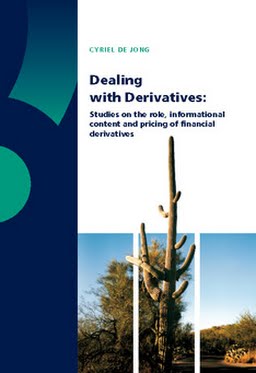
Dealing with Derivatives. Studies on the role, informational content and pricing of financial derivatives
The aim of this thesis is to improve the understanding of derivatives markets, which should ultimately lead to a better diversification of risks among market participants. The author first analyzes the impact of derivatives on the market quality of the underlying asset. With experiments and a theoretical model it is shown that derivatives generally make markets more efficient, although volatility may increase, depending on the exact market structure. Next, the author presents two methods that derive information about the underlying price process from traded options. The models approximate the option prices well and the extracted information explains future volatility better than historical data. Finally, a model for the valuation of options in electricity markets is presented that deals with the special characteristics of electricity spot prices and may serve to value electricity generation plants.
Empirical Studies on Financial Intermediation and Corporate Policies
This thesis investigates the impact of financial intermediaries on capital structures, corporate governance structures and the performance of firms. Throughout the world, financial intermediaries have powerful and influential positions in financial markets. The intermediaries have both the incentives and the means to influence the financial policies of the firms and initiate governance changes in underperforming management teams. On the contrary, investors have limited ability to exercise control, even though they provide debt and equity financing to firms. This thesis comprises four empirical studies. In the first study, the author analyses the impact of information asymmetry between the U.S. firms and their lenders on firms’ choice of debt maturity. The second study shows how firm-bank relations in the form of shared board positions and equity ownerships influence capital structure decisions of Dutch firms. The following examination in the third study of Dutch managerial and supervisory board turnover further demonstrates the strong position of financial institutions in disciplining underperforming management. The fourth and final analysis in this thesis relates the dispersion in analyst forecasts to the differences in investor opinions and investigates how the heterogeneity of investor beliefs affects prices of European stocks.
Empirical Studies on Cash Payments
Jeanine Kippers (1973) obtained her master´s degree in econometrics from the Erasmus University Rotterdam in 1997. In the same year she was employed by De Nederlandsche Bank. She participated in the preparations of the cash changeover from guilder to euro in 2002, and contributed to the development of a European cash distribution system and the restructuring of the national distribution system. During her employment at the central bank she started her research on currency use, which resulted in several papers that have been published or are currently under review. In January 2004 she joined the Pensionand Insurance Supervisory authority, as a policy advisor in the (international) field of insurance supervision.
Banking across Borders
The study examines the internationalization strategies of the world’s largest banks between 1980 and 2000. These banks have dominated the internationalization of banking. For 44 banks, commonalities and differences are identified on the basis of a strategic typology developed for this study. The central research question deals with the effectiveness of internationalization. Using a self constructed internationalization database, differences are estimated between foreign and domestic performance, and the effects on shareholder return. A higher degree of internationalization has on average contributed negatively to bank performance. Similarly, shareholders have not gained by more internationalization. Banks who retreated from their internationalization or banks with a long established internationalization strategy generated the highest total shareholder return. Banks who (strongly) increased their internationalization generated the least returns. The study also addresses the future outlook for international banking - how will the internationalization of banks proceed? The potential for further financial deregulation in the home country, uncertainty on the international regulatory regime, and the business mix of the bank are likely drivers for the bank's future internationalization strategy and profitability enhancement.
Subscribe to:
Posts (Atom)
Das Kapital
Das Kapital by Karl Marx My rating: 5 of 5 stars Karl Marx's Capital can be read as a work of economics, sociology and history. He...
-
Das Kapital by Karl Marx My rating: 5 of 5 stars Karl Marx's Capital can be read as a work of economics, sociology and history. He...